
2.D. Creating A Profile That Converts
The ultimate Hopscotch directory profile guide: 8 easy steps to creating a stellar provider profile that converts
Hopscotch is proud to have an exclusive network of exceptional pediatric mental health providers. Hopscotch is so much more than just a therapist directory – we are a support system for child and adolescent mental health providers who are eager to grow their practice and expand the communities they serve. Our goal is to partner with you as you grow your private practice.
We want to help make it as easy as possible for prospective clients to not only find you in our directory, but to also feel a connection to you based on your profile, and then schedule an appointment with you.
One of the best ways for you to get the most out of our collaboration is to ensure that your Hopscotch directory profile is top-notch. To create a profile that converts visitors to appointments, let’s start by imagining the prospective client.
Who are they? And why are they searching for a therapist such as yourself?
Even though you are a child- adolescent therapist, your prospective clients (at least in the beginning) are parents. And, chances are they are concerned parents, who are likely feeling some emotional distress and are seeking someone who understands exactly what they and their child are going through. As they begin reading Hopscotch therapist profiles, their goal is to find someone who can help them ease the pain they are experiencing, and their minds are probably full of understandable parental concerns such as…
- Will this work?
- Will they understand our unique situation?
- Will my child see them as friendly and approachable?
- Will I be able to trust them?
- Will they be able to help my child?
- Why does “getting help” feel so intimidating?
- Am I a good parent?
- What will the therapist think of me?
An important part of the work we do as a child or adolescent therapist, is to meet the parents of our young clients exactly where they are at and forge a relatable and trustworthy bond with them. We also want them to feel confident that they are reaching out to the right person to help their family. To do this, we need to make a stellar first impression, and your Hopscotch therapist profile is a great place to begin.
A comprehensive profile can be incredibly helpful with driving appointment requests. To get you started, we’ve put together a comprehensive guide for completing your directory profile to help set you up for success.
Step #1 – Log into your Hopscotch account
When you log in, you will be immediately directed to your Home page.
On the left-hand navigation bar, click on "Profile."
To work on your directory profile, you will be working in the “Directory Profile” Section. This is the public-facing section of your profile.
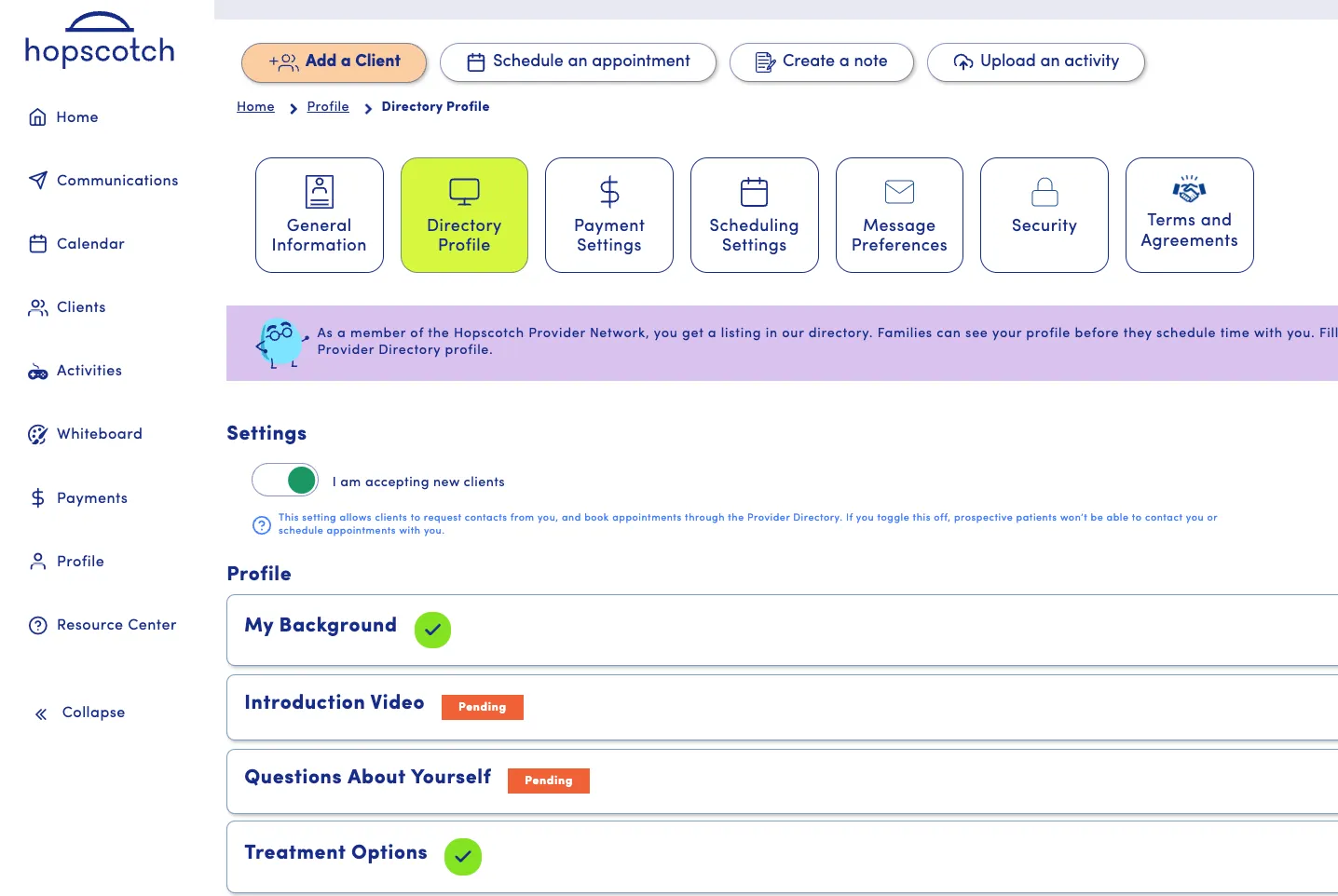
Step #2 – Click on “My Background”

You will see two bolded sections, “Profile Picture” and “About You.”
Profile Picture
See section 2.A. where we outline tips for a fantastic profile picture
About You
Share your story and write a powerful “About You” section. After indicating your years of experience, your next task is to complete the section entitled “Tell us a story about yourself as a clinician.” This will appear to the public on your profile under “Professional Summary” next to your picture. You have 2500 words or less for this section.
The first two sentences of the “About You” section is the most important part, because this is what most prospective clients read first. Your priority for the first two sentences is to A) acknowledge and validate their pain, and B) establish a connection with them by speaking directly to their experiences. Try and vanquish their feelings of isolation, guilt, and anxiety by using strong connection words such as together, we, and our so that everything you say conveys hope.
IE: As a parent, it is heartbreaking to see your child struggle with headaches, sleep issues, and panic attacks. Together, we will discover therapeutic grounding techniques to help your child gain control over their anxiety.
Because this “About You” section is so important, here are some additional helpful dos and don’ts:
The top 5 definitely DO’s…
- Address the immediate need. Pain is the immediate need to address. Sadness, frustration, stress-induced sleepless nights, worry… These needs are not addressed by informing clients about your psychodynamic counseling background. Most clients will not even know what that is. Avoid excessive technical jargon or overly clinical terminology and simply reassure them that you “get it.”
- Be friendly. Connecting with a new counselor can be a vulnerable experience for many people. Make it easy for them by sharing your approachable personality with them.
- Use empathy to convey trustworthiness. Activate empathy and imagine what the prospective client looking at your profile might be feeling, and then speak directly to those feelings. If you are unsure of where to begin, consider what have you said to your current clients that helped them feel instantly at ease. Speak from the heart.
- Speak directly to your niche. A “one size fits all” bio with an all-inclusive tone of voice is unable to convert the way a hyper-specific bio can. For your profile to resonate with your ideal client, you must speak directly to the exact type of client you specialize in supporting.
Does your profile with Hopscotch (and any external profiles you may have such as social media profiles, websites, etc.) speak to your ideal client?
- Does your profile acknowledge client pain points and effectively communicate that you see and understand them? (or have you focused mostly on you and your education and skills). i.e. How many times did you use the word “I” or “my” vs. “you” “your child” or “clients” in your profile?
- Did you begin your profile summary by trying to connect with your potential client? (i.e. Are you tired of all the conflict in your family and you need a therapist (ally, someone) to help you find a more peaceful way to communicate? I can help.)
- Is your “specialty” clearly articulated?
- How do you verbalize the way you work and the outcomes your clients receive (without making false promises or giving unrealistic expectations)?
5. Include hope for the future. Highlight positive takeaways clients can gain from sessions with you. Will their child’s anxiety become more manageable? Will they learn grounding methods for coping with grief? Articulate that progress is possible, and then help them visualize what progressive healing or recovery looks like.
The top 5 definitely DON’TS…
- Don’t speak like a therapist. A powerful profile is an authentic profile, and the best way to be authentic is to simply be yourself. Write to your prospective client like you might write to a close friend, and use simple words and a conversational tone instead of a lot of therapeutic jargon.
- Don’t use third person. IE: Mrs. Smith is a licensed clinical social worker… She graduated from… Instead, write from a first-person narrative. IE: My name is Michelle, and I am a licensed clinical social worker…I graduated from…
- Don’t focus too much about yourself, your approach, or your professional certifications/qualifications. Remember: the primary purpose of your profile is to focus on what your client needs. In a way, your “About You” section is really about them. Don’t list your qualifications in the “About You” section. Briefly mention your 20 years of experience working with adolescents, or in the field of adoption, for instance, but use the “Professional Credentials” section below to indicate your license and the “Questions About Yourself” section to feature your certifications. You’ll use the “Therapy Approaches” section to indicate your approaches to treatment.
- Don’t let imposter syndrome take over. Talking confidently about how credible, trustworthy, competent, and qualified you are can feel a bit awkward. But let’s be honest… you are extremely credible, trustworthy, competent, and qualified! And the best way for you to help your future clients, is to let your credible, trustworthy, competent, and qualified self, confidently shine. Trust us… You got this! 😊
Languages
The last part of this section is selecting what languages you are fluent in.
Choose all that apply.

Step #3 – Introduction Video
Did you know you can add a welcome video? This is just one more way to create engagement with your potential client. Add a video introducing yourself to help clients get to know the real you. We get it, most people prefer not to video themselves, but adding a short, 2-3-minute-long video is a personable way to make a strong first impression, encourage a connection, and set you apart from other clinicians. FYI, directory profiles with a video are way more likely to convert.
Helpful hints for the best video:
- MP4 files are the only format accepted, with a 250MB maximum file size.
- You can drag and drop your video into the box or click to upload.
- Your whole face should be clearly visible. A medium close-up shot that frames your entire head, face, shoulders, to about halfway down your upper torso is ideal.
- Be sure to smile and wear neat, casual, business attire.
- Your video should be of just you, your therapy animal and/or your therapy space.
- If showing your therapy space, make sure you take a look around before you start filming. People will notice things you may not realize are there. Do you want them to see family photos on the wall or on your bookshelf? How does your space reflect who you are? Is there anything that would offend a potential caregiver for be inappropriate for a child or teen? If so, remove those before filming.
- Select a space where there is minimal to no background noise.

Step #4 - Questions About Yourself (optional)
Get personal and let parents and clients learn more about you.
The more sections you complete, the better, because all profile sections are connected to our search features.
Step #5 – Treatment Options
In this section you will be highlighting your location and clarifying your specialties to indicate important information that will be used for search criteria for potential clients and used by Hopscotch to rank search results. Be comprehensive. Everything you add helps prospective clients find you.
- Ages you work with.
Use the slider to indicate the minimum and maximum ages you will accept as a client.
- What you specialize in.
Check all of the diagnosis categories that you will work with.
- Concerns you treat.
Check all of the presenting issues within your scope of practice that you will treat.
Step #6 – Therapy Approaches
Again, being thorough is important. Add every therapeutic approach within your training and experience that you can administer.
Step #7 - Professional Credentials
Click on “Professional Credentials”
In this section you will indicate your licenses and professional certifications. Select all that apply.
You also have a section to enter any specialized training/certifications you have received.
Step #8 - Lastly, remember to proofread!
Before you finalize your profile and it’s made public, be sure to double and triple check your work. Watch out for spelling mistakes, grammatical errors, capitalization, punctuation, accuracy, correct terminology for certifications, etc. You may even want to have a trusted friend, colleague or family member review.
That’s it! Now you have a stellar profile!
Need help with your profile?
Our supportive team at Hopscotch is ready to assist you with creating the most powerful and engaging profile possible.
1) Set up an appointment with Michelle at https://calendly.com/michelle-rigg/15minutes and let's work on it out together.
2) Email us at [email protected] to request assistance or to get feedback on your profile.